Alarm clock for heavy sleepers: what really works
Still in the feed at 2 a.m., alarm at 6:30: short nights mean deeper sleep. Which alarm clock for heavy sleepers really works.
You’re looking for an alarm clock for heavy sleepers because you sleep straight through yours or switch it off half asleep. Before you buy the loudest device on the market, one honest sentence: today’s most common heavy sleeper isn’t a medical case. It’s someone who was still in the feed at 2 a.m. and has to be up at 6:30 a.m.
Here’s which kinds of alarms really do wake you — the sound, vibration, light, several alarms, an alarm with a mission — and how to set yours tonight, in five minutes, so it gets through to you tomorrow.
At a glance
- Low tone
- not a high beep
- Door closed
- 15–20 dB quieter
- Sleep need
- 7 hours or more
- Snoozing
- 56% of nights
The heavy sleeper of today
Do the math. Into bed at 11:30 p.m., one more video, then another — and suddenly it’s 2 a.m. Until 6:30 a.m. that’s four and a half hours. Adults need seven hours or more on a regular basis.
And now the connection almost nobody knows about: too little sleep makes you harder to wake. After short nights your body catches up on deep sleep, above all in the first half of the night. That’s why research puts a lack of sleep on the same list as alcohol, sleeping pills and noise in the room: as a reason for sleeping through an alarm. A single night of four hours is enough to make you respond measurably worse to sounds while you sleep.
That doesn’t mean something is wrong with you. It means you don’t have a character problem, you have an evening problem. And your alarm is working against a backlog it can’t make up.
How your evening gets an ending is a subject of its own. This is about the other half of the answer: which alarm gets you out when you really do sleep deeply?
Seven reasons you don’t hear it
Very often it isn’t you and it isn’t the device — it’s some small thing from the evening before. Go through the list once. Two of them switched off, and plenty of heavy sleepers hear their alarm again.
- Headphones or earplugs in your ears. You fall asleep to music or an audiobook, or you plug your ears because it’s loud outside — then the alarm out in the room is competing with something sitting right inside your ear. If you sleep like that, you need vibration at the bed.
- Your phone is still on silent from the movie theater, a meeting, the evening on the couch. The classic, and in the morning you notice too late.
- Do Not Disturb or a focus mode is still running. Modes like that can suppress sounds. On iPhone, allowing time-sensitive notifications helps against that.
- Your phone is under the pillow or under the covers. Fabric muffles, and behind a closed door a signal loses 15 to 20 decibels — from the next room it wakes you that much less.
- A fan, the street, a roommate, the snoring next to you. Background noise in the room is one of the hard reasons for not waking up, because it masks the alarm.
- The battery. If you’re in three group chats at night, you put the phone down at 2 a.m. nearly empty and don’t plug it in. A dead phone doesn’t ring.
- Your week is irregular. Two hours longer in bed at the weekend, the same alarm on Monday: as far as your body is concerned, it’s ringing in the middle of the night. Catching up doesn’t simply add up.
Wakea – Wake Up Alarm Clock
Alarm clock for heavy sleepers. Wake-up missions to stop snoozing and get up.


3-day free trial
Alarm clock sound for heavy sleepers
The sound is the strongest lever and the least known one — stronger than the volume. Low, full tones wake you more reliably than a high beep: in test series, a high beep needed about 13 decibels more for the same effect, so roughly twice the perceived loudness. It looks like a matter of frequency, not of urgency — a woman’s voice woke people no better than a low, mixed tone.
Trouble is, no sound list says “low and full.” Here’s how to spot it in ten seconds: in the evening, play your sounds at normal room volume. A gong, a bell, a rumble and a deep hum are candidates; beeping, chirping and birdsong are out. The duller, the better — a gong rather than a beep. When in doubt, take the lowest sound on your list. Melodic with a rhythm does no harm: people with melodic alarm sounds report feeling less groggy after waking up — that says nothing about how well the sound wakes you. If the two clash, low comes before melodic.
Volume comes only after that — and there the curve is flat: with children, the jump from an alarm out in the hallway to a very loud one above the bed still got only about half of them reliably out of sleep. At the same level, the low tone woke far more adults than the high beep. So you don’t need a record-breaking alarm.
Haven’t heard yours in a while? People really do get used to noises in their sleep — for your own alarm sound, that hasn’t been studied. The likelier answer is something that has changed: shorter nights, a new background noise, alcohol.
The answer isn’t louder. It’s lower, closer to the bed, and up before you decide.
So the alarm actually gets through
An alarm app can ask more of you than a swipe — that’s the difference from the clock that’s already on your phone. In return it has one condition, and that is the most common reason for a silent morning.
- Allow notifications. An alarm from an app rings through a delivered notification; without the permission it stays silent — with no warning.
- On iPhone, also allow time-sensitive notifications so your alarm still reaches you in a sleep focus.
- On Android, turn on “Boost volume when ringing.” The switch sits in the app’s settings, not in the system, and it raises the alarm volume when it rings.
- Test the alarm once. Set it two minutes out, lie down, listen — after that you know instead of hoping.
To be honest about it: a phone on silent stays a gap that no alarm app can get around. Anyone who is hard of hearing or deaf needs vibration at the bed. For everyone else, two minutes of checking is all it takes — and then you’ll be woken even offline.
Vibrating alarm clock and light
Vibrating alarms come as a wristband, a pillow shaker or a unit for under the mattress. For people who don’t hear tones well they’re the most important route, and they spare whoever is lying next to you. As a solution on their own they’re weaker than their reputation: at the factory setting, pillow and bed shakers woke about four out of five people with hearing loss — one in five slept through, and after alcohol considerably more. A low tone did better. Vibration gets strong when it pulses and sits close to the sleeper, so under the pillow or the mattress. A phone buzzing on the mattress and a band on your wrist are a different thing: on top of a sound, a good plan; instead of a sound, a bet.
Devices that slowly get brighter before your wake-up time are pleasant — but as a wake-up signal they’re unreliable. So far only the harsh strobe lights used in fire safety have been tested, and most people slept through those; with a sleep mask or a blackout blind, light does little anyway. The reliable, free part is the other one: once you’re up, blinds open and out the door for a minute.
Four alarms, and still late
Hitting snooze is completely normal. In an analysis of millions of nights, more than half ended with snoozing — on those mornings 2.4 times on average, for just under 11 minutes. That a chain of alarms trains your brain to ignore them is not proven. The objection is a different one: it moves the decision into the minutes when you’re least able to make it. The grogginess right after waking up usually lasts 15 to 30 minutes, longer after a short night — and that’s exactly when you start negotiating with yourself.
- Work out the latest sensible wake-up time: with a stopwatch, time how long you need from getting up to the door, plus five minutes of buffer.
- One alarm that counts — for something genuinely important, at most a second one as a safety net, far enough apart that you’d long since be up.
- Get up at the first alarm, don’t negotiate.
“Put the phone farther away” helps, because you’re on your feet before you decide. But anyone who gets up half asleep lies back down half asleep — and behind a closed bedroom door you hear it less well. The compromise: in the bedroom, out of arm’s reach, charging cable on the desk or the dresser. And the math in 90-minute steps, so the alarm lands in a light phase? For hearing it, that does nothing.
Wakea – Wake Up Alarm Clock
Alarm clock for heavy sleepers. Wake-up missions to stop snoozing and get up.
3-day free trial
Alarm clock that gets you out of bed
Alarms that demand an action come in many forms. For one of them there’s actually evidence — and it isn’t mental arithmetic. Researchers have found that a short bout of movement right after the alarm leaves you more awake than memorizing numbers or pressing a button. The order you can copy: breathe and circle your arms first, then ten squats.
Movement won’t clear your head in seconds — it keeps you out of bed. A math problem won’t; you can solve that lying down. And “won’t I get used to this too?” Whether you get used to getting up hasn’t been studied — when a trick stops working, there’s usually too little sleep behind it again.
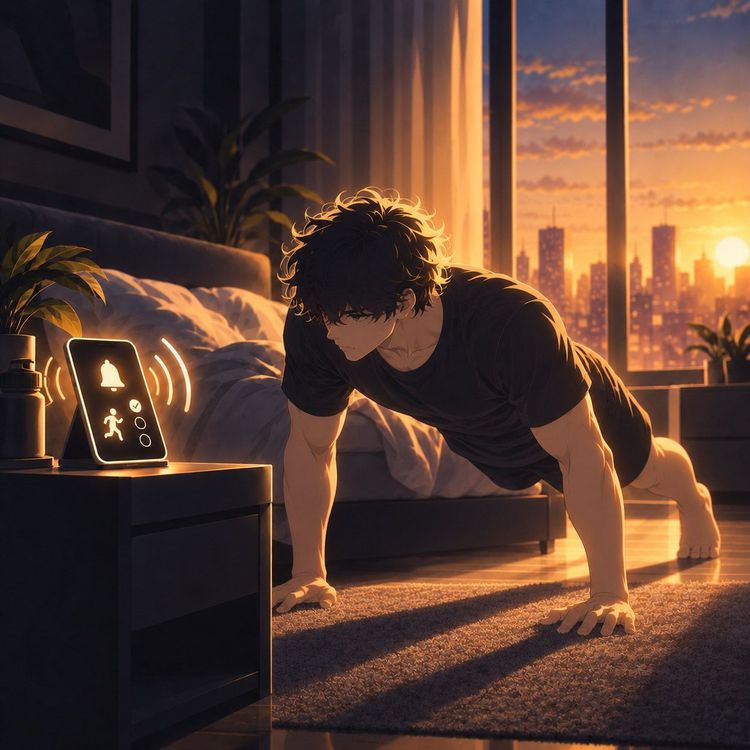
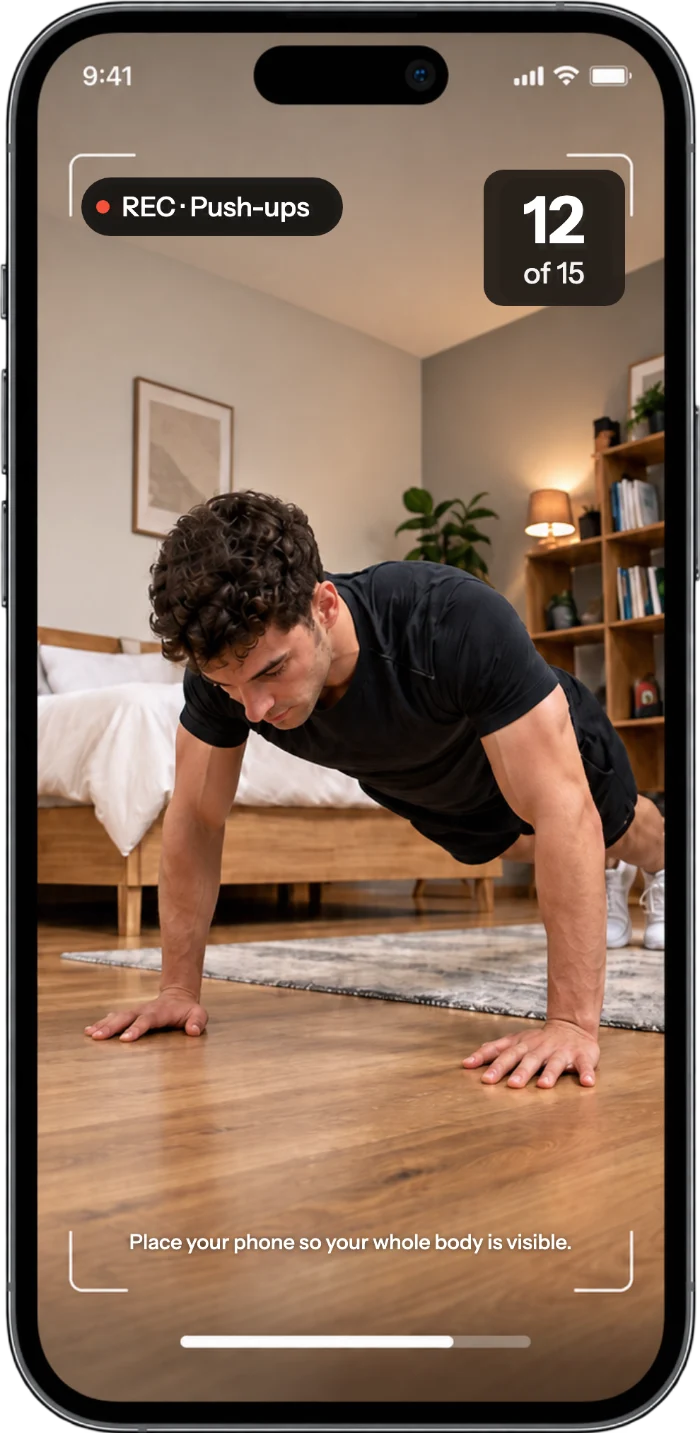
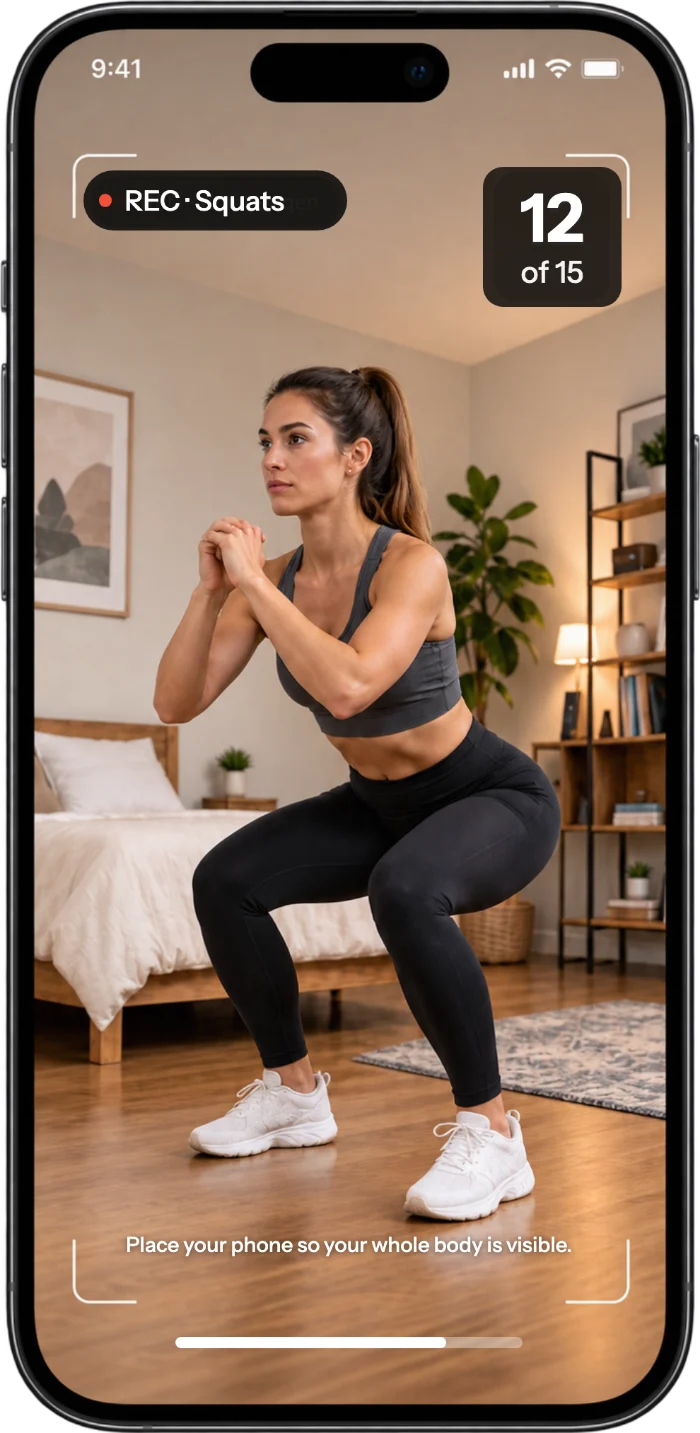
That’s exactly what Wakea is built on: the alarm goes off once you’ve completed a mission — squats, push-ups or making your bed. The front camera counts right on the device, and photos and videos are never saved or uploaded. There is no snooze button.
What almost everyone asks first: what if I can’t manage it in the morning? You’re not locked in — an emergency exit is there on purpose, and the ringing ends after a while; a morning without a confirmation simply doesn’t count toward your streak. If a mission is too much, turn the difficulty down or take the bed mission: there the camera checks whether the bed is made, with no reps.
You decide in the evening. In the morning you only carry it out.
The morning after
Now the part that makes all of this worth it. Get up at the first alarm and you win the morning back: feet on the floor, sit on the edge of the bed for a moment, up slowly, a sip of water, a few squats — and out of the bedroom. Stay lying down and you start negotiating.
Over time, that short bout of movement is the opposite of exhausting: even a fifteen-minute walk gives you energy, and people who move regularly are less tired in the long run, not more. Five squats are not a workout — but they pay into what adults are advised to get: 150 minutes a week plus two sessions for the muscles. Start with five, not thirty, and get up from lying down slowly; the signs to stop are in the box at the end.
In the end the best part isn’t the alarm, it’s the morning you no longer have to apologize for. You’re dressed, you’ve moved, and it’s only a quarter past seven. That’s the difference between a day you lead and a day you chase.
Wakea – Wake Up Alarm Clock
Alarm clock for heavy sleepers. Wake-up missions to stop snoozing and get up.
3-day free trial
Tonight, five minutes
The trick behind all of it: you decide in the evening, in the morning you only carry it out. Five minutes:
- Set the wake-up time — the latest sensible one, not the one with a snooze buffer.
- Set the alarm sound to something low and full, and play it once.
- Headphones and earplugs out, device volume up, sound back on.
- Check notifications, on iPhone the time-sensitive ones too; on Android turn on “Boost volume when ringing.”
- Phone on the charging cable, out of arm’s reach: the desk or the dresser.
- Test the alarm once.
And the part no alarm replaces: plan for seven hours, and keep similar times at the weekend. Cut caffeine in the afternoon, at least four hours before bed, better six. Alcohol raises your waking threshold measurably. And don’t stay awake out of fear of sleeping through your alarm — that makes the next day dangerous.
Frequently asked questions
Why do I sleep through my alarm?
Usually two things come together. First, too little sleep: after short nights your body catches up on deep sleep, and in research a lack of sleep counts as a reason for sleeping through an alarm. Second, some small thing from the evening: headphones in your ears, the phone on silent, Do Not Disturb still on, the device under your pillow, a dead battery, a fan that masks everything. Go through the list before you buy a louder alarm clock; you get to the sound only after that.
Which alarm sound should I set so I don’t sleep through it?
A low, full one: a high beep needs about 13 decibels more volume for the same effect. A ten-second test: play your sounds — a gong, a bell and a rumble are candidates, beeping and chirping are not.
Will the alarm ring on Do Not Disturb or on silent?
An alarm from an app rings through a delivered notification; without that permission it stays silent. Do Not Disturb and focus modes can suppress an alarm — that’s why on iPhone you also allow time-sensitive notifications, so your alarm still reaches you in a sleep focus. A phone on silent, though, stays a gap that no alarm app can get around, on Android just the same. So: leave the volume up, and test the alarm once in the evening.
How do I wake up a heavy sleeper?
Not louder, lower: at the same level, a full tone wakes people more reliably than a high beep, and it bothers the household less. Add vibration under the pillow or under the mattress. With teenagers, check bedtime first — they need 8–10 hours.
Do vibrating alarm clocks or wake-up lights work for heavy sleepers?
As an addition yes, on their own no. At the factory setting, pillow and bed shakers woke about four out of five people with hearing loss, pulsing better than continuous; a low tone did better than both. For light that slowly gets brighter as a wake-up signal the evidence is missing — light works after you’re up, not as a wake-up call.
Is there an alarm clock that makes you get out of bed?
In Wakea the alarm goes off once you’ve completed a mission: squats, push-ups or making your bed, checked by the front camera on the device. There is no snooze button; an emergency exit, though, is built in on purpose.
How do I stop hitting the snooze button?
In three steps: recalculate your wake-up time (with a stopwatch, time how long you need from getting up to the door, plus five minutes of buffer), keep at most one safety-net alarm, and at the first alarm immediately do something you have to stand up for.
I overslept and I’m late — what do I do now?
Let people know briefly and matter-of-factly, then set off calmly. In the first 15 to 30 minutes after an abrupt awakening you’re not fully there — avoid driving if you can. If you get tired at the wheel, the only thing that helps is pulling over and a short sleep. That evening you start again at step one, with no reckoning.