20 squats a day: what they really do every morning
What 20 squats a day in the morning really do, how to start safely with 5 — and what they can’t do.
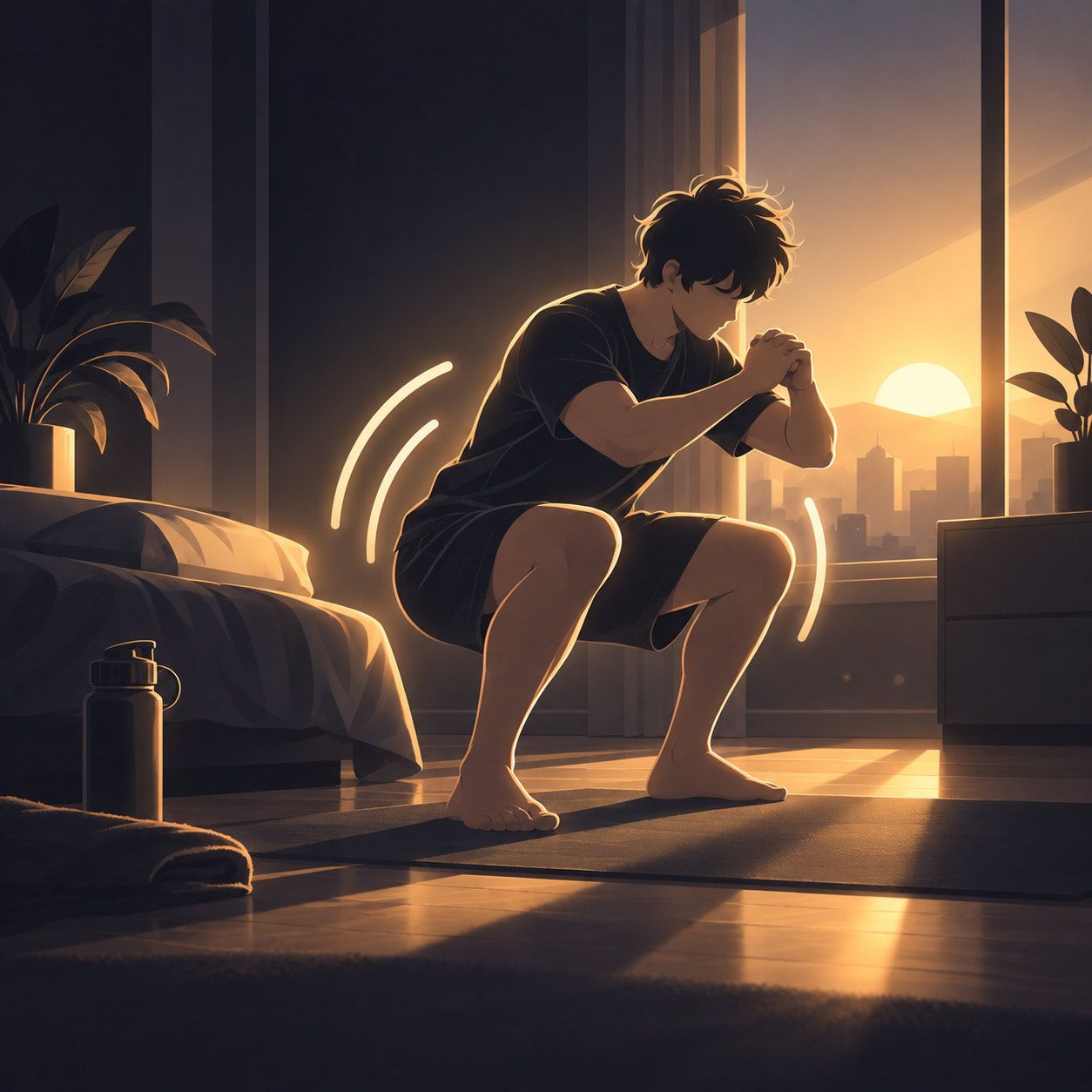
20 squats a day, done in the morning, won’t make you lean and won’t make you muscular. They do something else that’s worth more day to day: they get you out of bed before the argument with yourself starts. About 90 seconds, no commute, no locker room, no excuse. Here’s what 20 squats every morning do, how to do them right, how to start if you can’t manage a single one — and what they can’t do.
At a glance
- Whole routine
- about 90 sec.
- Start
- 5–10, not 20
- Easier days
- about 8 weeks
- Habit
- from 2 months
What 20 squats a day really do
What 20 squats a day do shows up over two different time frames. Right away: muscle work does exactly what your body is already trying to do as you wake up — get blood moving, bring your temperature up. Early research suggests that a few minutes of movement right after the alarm make the first half hour easier: faster reactions, fewer blank moments. That is not proven. What is certain: movement keeps you out of bed.
The second one takes weeks and looks like nothing:
- Strength. Short daily bites of strength work make untrained people measurably stronger — you feel it getting up, you don’t see it in the mirror.
- Everyday life. The squat is the movement you do dozens of times a day: up from a chair, out of the car, off the couch.
- No equipment needed. Your own body weight is enough to get stronger — in one small study, a progressive bodyweight series came close to the strength gains of the barbell. Progressive means: harder variations at some point, not the same 20 forever.
Which muscles work in a squat: the front of your thighs pushes you up, your glutes extend the hips, the back of your thighs slows you on the way down, your calves hold your balance, and your core and back keep you upright. Almost everything you need in order to stand up, in one movement.
Why mornings are so hard
The reason almost nobody does something for themselves in the morning isn’t laziness, it’s the evening before. Half past eleven, one more video, the feed keeps running on its own, and so does the group chat. For other people it’s the last email at 10:30 p.m., laptop on the comforter. Wake up with five hours behind you and you won’t win any argument with yourself, and then comes the snooze button. Health-wise, snoozing is no disaster; it just blurs the time you actually get up, ten more minutes at a time. That is exactly the window the 20 squats take over: the action replaces the decision.
Three things for tonight that don’t ask you to give anything up:
- Give the episode you’re starting an ending first.
- Set an alarm for the evening: one more, then done.
- Charge your phone out of arm’s reach.
Wakea – Wake Up Alarm Clock
Alarm clock for heavy sleepers. Wake-up missions to stop snoozing and get up.


3-day free trial
How to do a squat properly
Doing squats properly works without a trainer and without a mirror. Five steps:
- Feet a little wider than hip-width, toes turned slightly out.
- Brace your stomach, chest up, eyes forward, arms out in front — that keeps you balanced.
- Push your hips back and down, as if you were about to sit on a chair behind you. Long back, no rounding.
- Knees point in the direction of your toes, heels stay on the floor.
- As deep as you can go without rounding your back and without pain — chair-seat height is plenty to start. Then push up through your whole foot.
Breathing is what almost everyone forgets. Only one thing matters: never hold your breath — straining drives your blood pressure up sharply for a moment. Which way you breathe is secondary; breathing in on the way down and out on the way up has worked well. Tempo about two seconds down, one second up — so 20 reps take around a minute. Always the same depth beats deep; you may go deeper, but you don’t have to. Your check without a mirror: heels down, knees over the middle of your feet, count out loud — if you can count, you’re not straining.
The mundane questions that really do come up in the morning:
- Barefoot or flat shoes, no thickly cushioned running shoes, no socks on laminate.
- Carpet, tile, floorboards: anything works, as long as the floor isn’t slippery.
- Pajamas are fine, and it’s quiet too — the neighbors won’t hear a thing.
As deep as you can go cleanly today. Tomorrow maybe a little more.
The most common mistakes
Three mistakes explain almost everything that goes wrong:
- The back rounds. Fix: go less deep, chest up, eyes forward instead of down at the floor.
- The heels lift. That’s almost always ankle mobility, not missing strength. First rule: only as deep as your heels stay down. If you like, put them on a flat, non-slip board — fully supported, so no stack of books on hardwood.
- The breath gets held. Fix: breathe out audibly on the way up.
And then the line you know: “Your knees must never go past your toes.” That’s a half-truth — hold them back on purpose and you only shift the load into your hips and lower back. What matters is the direction: knees follow toes. Cracking without pain is usually harmless; if it lasts for weeks or pain comes with it, get it checked. Shaky legs mean fatigue, not damage.
Squats with a chair or at the wall
Squats with a chair and squats at the wall are the way in if you can’t manage a single free-standing squat. Four stages, every one of them counts:
- Stand up from a chair and sit back down, no hands. Five times.
- Put the chair behind you, squat until the seat touches you, come back up.
- Free-standing squat down to chair height, arms out in front.
- Deeper, as long as your heels stay down and your back stays straight.
Stay on one stage until you manage all the reps for a week without holding on and without pain. If balance or your knees are the problem: one hand on the doorframe or on a sturdy chair back. In official beginner guides, five reps are the starting point.
At 60, 70 or 80 the same applies, and it applies if you carry a lot of weight too: partial depth, slow tempo, first stand up safely, then count.
If squatting hurts, the wall sit is the alternative: back against the wall, walk your feet forward, lower until your knees are at roughly a right angle, hold as long as you can keep breathing calmly, two or three times. Never strain — what to get checked out first is in the box at the end.
Squats every day — is that okay?
Doing squats every day is fine at 20 reps with your own body weight. The contradiction you find online has a simple reason: classic beginner recommendations describe a training workload — three sets of 10 to 20 reps with breaks in between, usually every other day. Twenty calm squats are a fraction of that. The rule of thumb: after the last rep, a few more have to be possible; you never need to go to exhaustion. All at once, or ten before and ten after brushing your teeth, is equally good.
How many squats a day make sense, in plain terms:
- Tomorrow morning: 5.
- This week: 5–10, the same number every morning.
- From week 2: 2–3 more per week, until you’re at 20.
- If a stage feels hard again a week later, stay there. Going back is not a step backwards.
Sore muscles in the first few days come with it: worst after one to three days, gone after about five to seven days. At the same dose they are much milder the next time; with every increase they come back. With bad soreness, a fever or a cold, you carry on shallower or skip the morning — both are right, just don’t stop. If 20 wipe you out, the dose or the night was too much, not the exercise.
Wakea – Wake Up Alarm Clock
Alarm clock for heavy sleepers. Wake-up missions to stop snoozing and get up.
3-day free trial
If you turn the alarm off in your sleep
Heavy sleepers know it: the alarm rings, your hand finds it, and later there is no memory of the moment left. Motivation doesn’t help against that — distance does.
- Alarm clock or phone out of arm’s reach — set up on a dresser or a chair, facing the cleared square of floor you’re about to stand on.
- One alarm instead of a chain of three — not because a chain teaches you to ignore it, but because it moves the decision into the minutes when you make it worst.
- Stand up first, then turn it off. In that order, every time.
And once you’re standing anyway, the 20 squats are the logical next movement. Opening the curtains is part of it — and if you can, step outside for a moment: morning daylight pulls your rhythm earlier. It won’t make you instantly awake, and the ceiling light is far too weak for it.
Myth: 10 squats = 10,000 steps
The line is everywhere, and it is wrong: there is no study that equates 10 squats with 10,000 steps. Squats and walking do different things — one makes you stronger, the other keeps you moving.
The 10,000 itself is the name of an old pedometer; things get measurably better from as few as 3,000 to 4,000 steps, and most of the benefit is reached at around 7,000. You don’t have to choose.
What 20 squats can’t do
- Lose weight. A minute of movement costs a few calories, no more. What helps with weight is a more active life overall — this minute is a start for that, not a shortcut.
- Replace the activity guidelines. The recommendation is 150–300 minutes of moderate activity a week plus strengthening all the major muscle groups on at least two days. Since 2020 every bit of movement counts, the short kind too — your minute is part of it, but it doesn’t cover everything.
- Replace sleep. Adults mostly need seven hours or more; if you’re permanently below that, no morning exercise will bring it back.
- Be a treatment. Movement helps more with back pain than taking it easy does; whether this particular exercise eases it has not been studied.
How to keep it going
Count on about two months before it feels automatic. For half of the people studied it took around 60 days; for many it took considerably longer, up to several months. Forget the 21 days. From practice, not from studies: after a few days you no longer have to think about where you stand, and after two or three weeks getting up before switching off becomes noticeably easier.
- A fixed trigger instead of a resolution: “When the alarm rings, I do my squats.” A fixed time carries just as well as an existing routine. On shifts you hang them on the alarm, whenever it rings.
- It has to feel good. The people who stuck with it got something out of it that paid off in the moment — not the more perfect program. That’s why 20 and not 50.
A missed morning is not a failure; one skipped day made no difference to the outcome. On bad days five instead of twenty, but not zero. After a break of more than a week you start with half the number. You don’t need a 30-day challenge — it ends, and your habit is meant to stay.
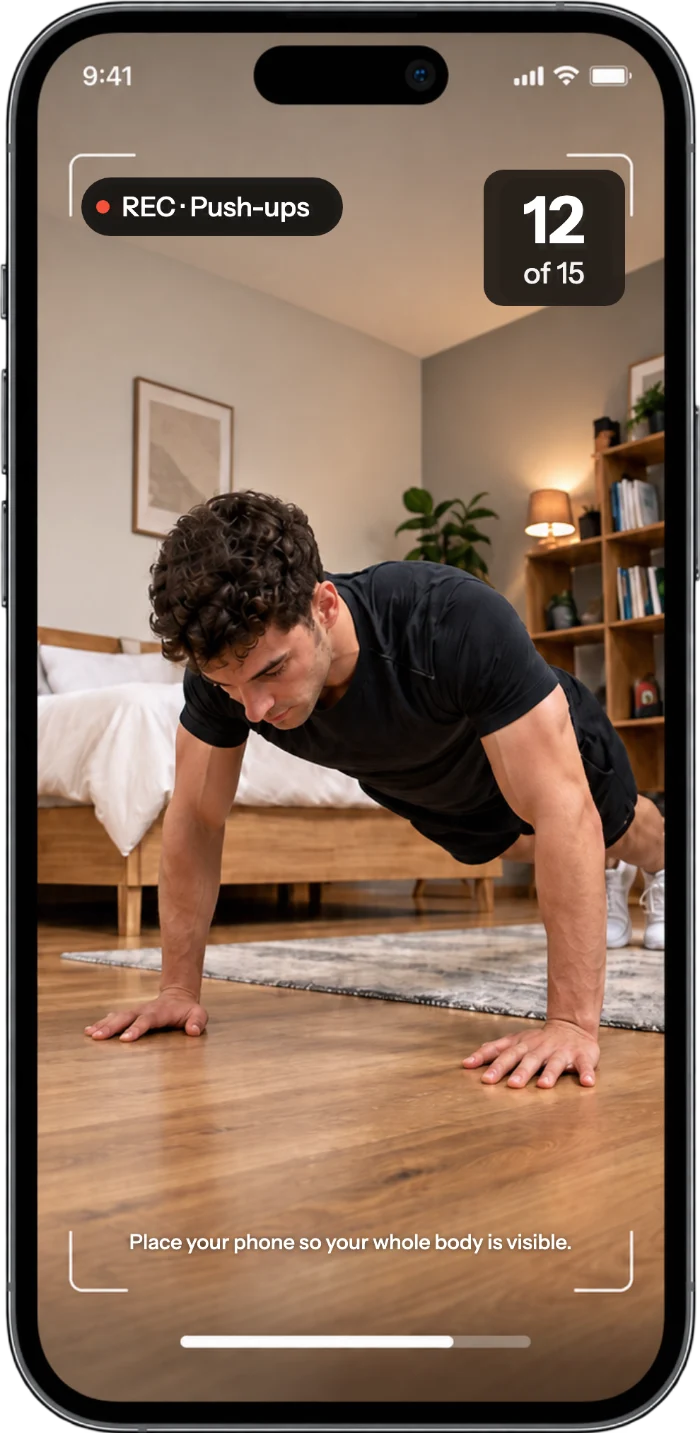
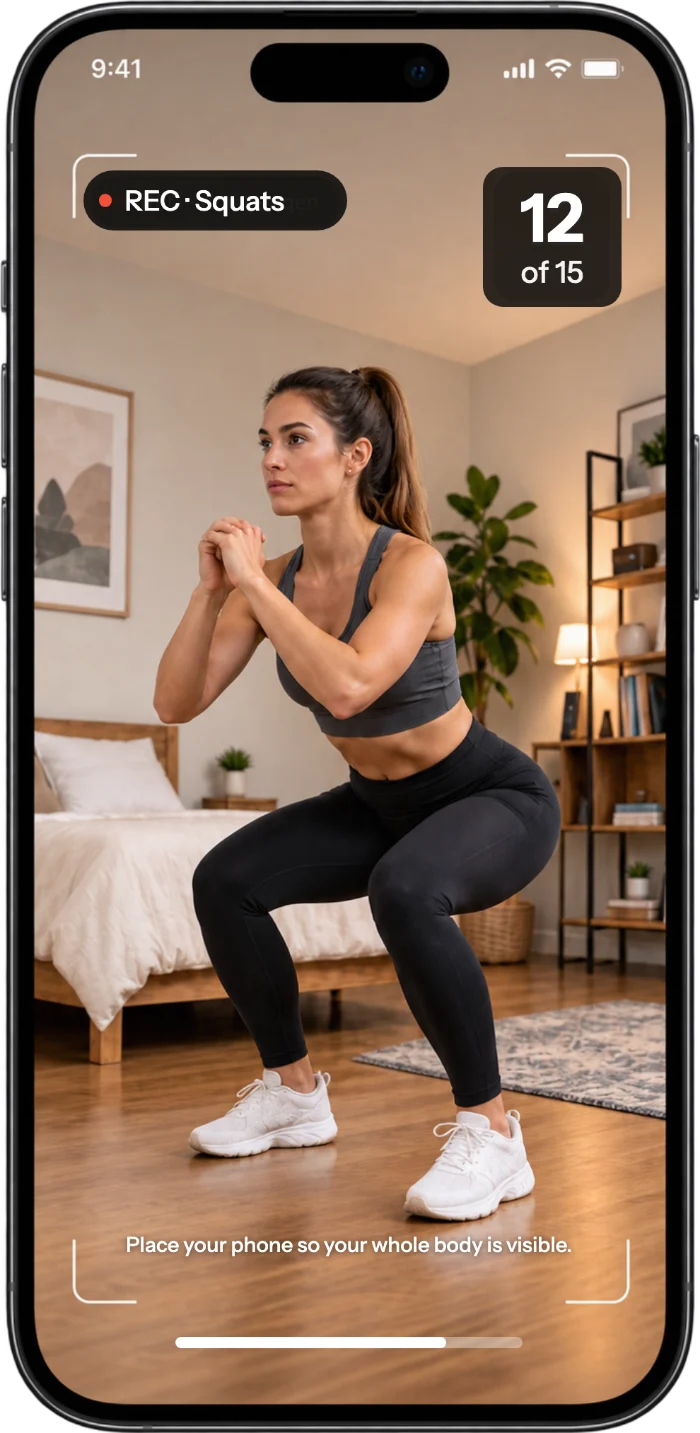
If you want your alarm to help with this: Wakea has a squat mission — the alarm doesn’t go off until the reps are counted. The front camera counts them right on your device; photos and videos are not saved or uploaded. How demanding the mission is, you set per alarm with the difficulty — feel free to start with the easiest; the fine progression from five to twenty stays your own exercise. For the alarm to ring at all, you need permission for notifications, and on the iPhone the time-sensitive ones as well; after that, let it ring once as a test. You are not locked in — a way out is there on purpose, and the ringing stops after a while; a morning without a confirmation just doesn’t count towards your streak.
Wakea – Wake Up Alarm Clock
Alarm clock for heavy sleepers. Wake-up missions to stop snoozing and get up.
3-day free trial
When you’ll notice something
How long it takes for squats to work depends on what you’re looking at. In the first week you notice the morning itself: you’re into the day faster because one action is already behind you. After one to two weeks, 20 feel easier. After about two months everyday life gets easier — stairs, out of the car, up off the couch. That is exactly what became measurable first, and muscle thickness did not: visibly different legs or thicker thighs are not what you get from this.
A self-test with no equipment, ideally today: count how often you stand up from a chair in 30 seconds without using your hands. Write the number down and count again in eight weeks — in one study exactly this test got measurably better after about two months. Your own number is the benchmark, not the mirror.
And when 20 get too easy — meaning you manage every rep cleanly every morning for several weeks — it goes on in this order: slower on the way down; a short hold at the bottom; two sets; lunges; single-leg with one hand on the doorframe. The 20 may stay as your starting signal, even when you’re long past doing more.
You get better at everyday life long before anyone sees it in the mirror.
Tonight and tomorrow morning
The whole routine takes about 90 seconds. Three moves tonight:
- Clear a square yard of floor, right where you’ll be standing tomorrow.
- Set your phone up out of arm’s reach, facing that square of floor.
- Set one alarm, not three. Put your clothes out.
Tomorrow morning: sit on the edge of the bed for a moment, two or three deep breaths, stand up slowly, take a few steps. Three shallow squats, very slowly, as a warm-up — they count, so it isn’t 20 plus a warm-up. Then the rest at a calm pace, curtains open, a sip of water. Squats first, phone second.
If you know back pain: bending far forward or tying your shoes standing up is better left alone in the first hour after waking — in one study of people with chronic low back pain, that alone brought clearly fewer days of pain. That is exactly why the squat is the friendlier morning exercise: your back stays upright.
And on the morning you overslept and you’re rushing: three slow squats, in your pajamas, in the hallway. Don’t skip it. A habit lives off the bad days, not the good ones.
Frequently asked questions
Will 20 squats a day do anything?
A training program they are not; a good start they are: short daily bites of strength work make untrained people measurably stronger — you feel it getting up, you don’t see it in the mirror. The bigger win: 20 squats never fail for lack of time.
Is it okay to do squats every day?
At 20 reps with your own body weight, yes. The rule about rest days applies to a training workload made up of several sets — and 20 calm squats are a fraction of that. Rule of thumb: after the last rep, a few more have to be possible.
How deep should you go in a squat?
As deep as you can without rounding your back, without your heels lifting and without pain; chair-seat height is plenty to start. In a small study with older participants, everyday performance improved just as much with half depth as with full depth — muscle mass did not build measurably in either group. You may go deeper, but you don’t have to; the same depth every day matters more.
Squats in the morning or in the evening — which is better?
Strength is measurably higher in the evening, but the gains over weeks are similar. The morning is not biologically superior, it is more reliable: the alarm comes every day, the evening negotiates. Both together works too — the 20 in the morning as a starting signal, your actual workout in the evening.
Are squats bad for your knees?
For healthy knees, no: a review of fifteen studies found almost no increased risk of harm — the people studied, though, were already doing strength training, not people with existing knee problems. Cracking without pain is usually harmless; if it lasts for weeks or pain comes with it, get it checked. If your knee hurts, don’t push through: less deep, slower, hold on. With known knee osteoarthritis, movement and strengthening are part of the basic treatment, in an adapted form. The stop signs and what to get checked out first are in the box at the end.
Squats on an empty stomach, or after breakfast?
For 20 reps you don’t need breakfast; an empty stomach is fine. Two exceptions: anyone prone to dizziness or low blood pressure stands up especially slowly and drinks some water first. And movement can lower blood sugar — if you take insulin or sulfonylureas, plan activity with your doctor and keep fast-acting carbohydrates within reach.
How many squats should you manage at 60 or 70?
There is no number you would have to reach. Start with the chair version: stand up and sit down five times, holding on to the doorframe is allowed. As your benchmark, take the 30-second chair test and compare with your own number after one to two months. With dizziness, several medications or a fall in the past year, you practice with support for the first few weeks, never free-standing in a dark bedroom.